Homemade
Variac Circuit Explained
written by: Emmanuel Sunday Eshiet.
A commercial variable voltage
autotransformer is a costly device to procure. However through some simple
interlinking of a couple of ordinary transformers, different levels of mains voltages
quite comparable to the above may be obtained. The complete procedure is
explained herein.
·
A variable voltage autotransformer
(also known as variac) is a transformer which is able to transform or produce
AC mains voltages at different desired levels at its output. Thus unlike an
ordinary transformer its output voltage is not fixed, rather can be varied
manually to obtain more than a single voltage. The voltage obtained from such a
device is normally an AC at mains level, which may be higher or lower than the
applied input voltage depending upon its settings.
You may already be familiar with the
conventionally available autotransformers, which are normally toroidal in shape
and having a large knob on the top surface. The body is basically made up of a
laminated iron core with hundreds of copper windings well secured inside a
metal frame.
When an AC mains voltage is applied
to its terminals, each of its windings is subjected to different discrete
levels of voltage through magnetic induction, generated by the interaction
between the iron core and the windings. The central shaft or the knob is
mechanized in such a way that when it’s rotated, it uniformly selects each
subsequent copper winding smoothly and produces the corresponding voltage
levels at its terminated output. This voltage may range right from zero to the
maximum applied input voltage and above.
·
Wiring a
Homemade Variable Autotransformer

 Although
constructing the above type of an autotransformer at home would be impossible
and unaffordable, using a few normal step-down transformers and wiring those up
through some smart configurations can provide you with selectable voltages that
may be lower, equal, or higher than the normally available AC.
Although
constructing the above type of an autotransformer at home would be impossible
and unaffordable, using a few normal step-down transformers and wiring those up
through some smart configurations can provide you with selectable voltages that
may be lower, equal, or higher than the normally available AC.
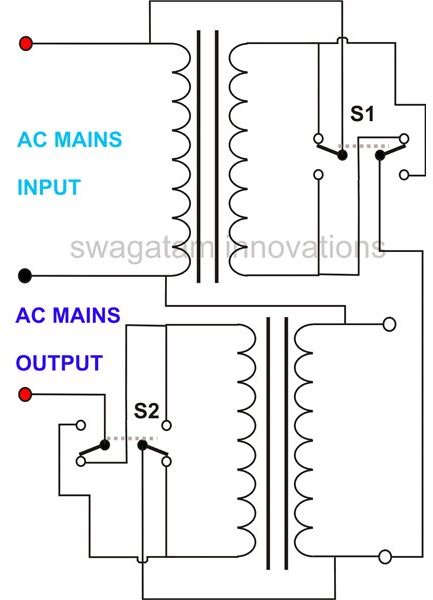
Referring to the diagram we see a
couple of ordinary step-down transformers wired up in series through switches
which are used to step up or step down the output voltages. Let’s try to
understand the operation through the following explanation:
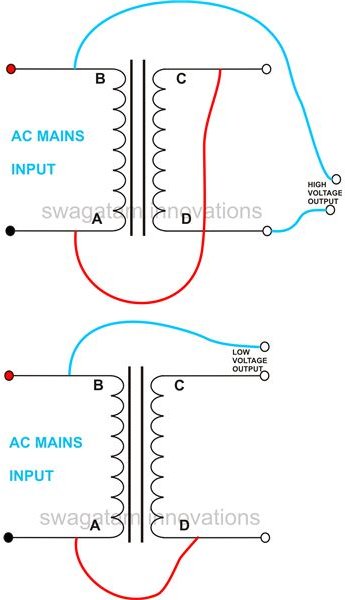
Just like many electronic
components, transformers too have polarities within their two windings. When AC
is applied to the primary winding of a transformer, an instantaneous positive
current (positive half cycle) flowing from the lower terminal A towards the
upper terminal B in the primary winding, will generate an instantaneous induced
positive current flow exactly in the opposite direction, i.e. from the upper
terminal C towards the lower terminal D in the secondary winding.
We know that when we connect two
batteries in series with one battery’s anode touching the second battery’s
cathode, we are able to sum up or add up their individual voltages together at
their free ends and vice versa.
Similarly, in the above case if we
connect the end A of the primary winding to the end C of the secondary winding,
we can add up the rated secondary voltage with the input AC supply, i.e. if the
secondary rating is 0-12V and the applied input is 220 Volts, the obtained
output here will be around 232 Volts across the free ends of the transformer.
Conversely, if we connect end A to
the end D, the secondary voltage gets deducted from the input AC and the
resultant output becomes 208 Volts across the free ends of the transformer.
In the present design of a variable
voltage autotransformer switches S1 and S2 conduct the operations exactly as
explained above and we are able to get different levels of voltages at the
output. Here we use two transformers just to make the output range wider and
receive voltages much higher or lower than the applied input AC voltage.
In voltage stabilizer circuits the
same concept is exploited, the only difference being that the switching there
is automatically done.
FOR YOUR AUTOMATIC
POWER SUPPLY SUCH AS POWER INVERTERS, HIGH POWER UPS, CHANGEOVER SWITCHES, AVR,
ETC CONTACT US 08069968877 or 07089216858, or Whatsapp me on those lines shown above.
Or email me on: emmasundayeshiet30@gmail.com or emmanueleshiet2acs@gmail.com.